Old stories never die

Every so often, a writer stumbles across an unexpected insight into their work. Not a new story idea, but something intrinsic to the way an author’s mind functions.
This week, that happened to me. It was triggered by a question from another author on social media, who asked whether other writers ever picked up previous work and took it through to publication. It made me think about my own old work, and led to the surprising discovery that sometimes long‑forgotten writing can weave its way into current projects without the writer even knowing.
Back in the late 1980s, long before The Earl’s Daughter or The 16th Earl’s Only Love existed, I wrote a contemporary romance with the working title Bitter Heart. Set in Sussex, it was written for Mills & Boon, and although it was liked by the editorial director whose desk it landed upon, it didn’t make it into print.
I reworked it a little, but then fate took hold of the steering wheel of my life. I found myself with no time for full‑length writing and shifted to short fiction for women’s magazines. But I never threw out that contemporary romance manuscript or its reworked versions. It remains somewhere in a storage box in my cottage, the paper yellowing with age, forgotten until this week. When that other writer asked about discarded work, I suddenly remembered that old manuscript from the eighties.
It centred around a Georgian manor in Sussex called Whyton House and a family named Carver‑Phelan. The hero was Matthew Carver‑Phelan: charming, flawed, aristocratic, and handsome, with buried secrets that were slowly destroying him.
And then the light went on. I saw the connection. A location, a family name, a character profile and a thread from then to now. Not a backstory, but a forward story, if such a thing exists. A thread leading from my past writing in the late 1980s to the present and the first book in the Aucourte Series, published in June 2026.
It’s true that there are no Aucourtes in that manuscript from the last century. The link is Carver‑Phelan.
I’d forgotten about Matthew Carver‑Phelan when I was writing The Earl’s Daughter, so I didn’t realise he was the great‑grandson of Anthony Carver‑Phelan — an important character who appears in most of the early books in the Aucourte Series.
Here’s the family line:
Anthony Carver‑Phelan and Mary Carver‑Phelan née Beaumont have three children: twin boys and a girl. Robert Carver‑Phelan, the younger twin, marries Sarah Aucourte‑Fraser, only daughter of Tom Fraser and Lady Alice Aucourte. Robert and Sarah have three children. Their eldest son, Daniel, fathers two sons and a daughter. The younger son is Matthew Carver‑Phelan. From 1892 to 1988, nearly a hundred years, and most of them still to be written in the Aucourte Series.
In other words: the contemporary novel I wrote decades ago was already part of the Aucourte world. I just didn’t know it then. What I thought was a standalone contemporary novel turns out to have been a future branch of the same family tree. Its connection to my current work completely unrecognised until a fellow writer got me thinking by asking a question on social media and the whole Aucourte / Carver‑Phelan lineage became apparent, including that abandoned manuscript from the 20th century.
It’s an enormous web of people, all with their own dramas, heartbreaks, triumphs, and secrets — and who knows, maybe Matthew from that first book may emerge into publication sometime in the future.
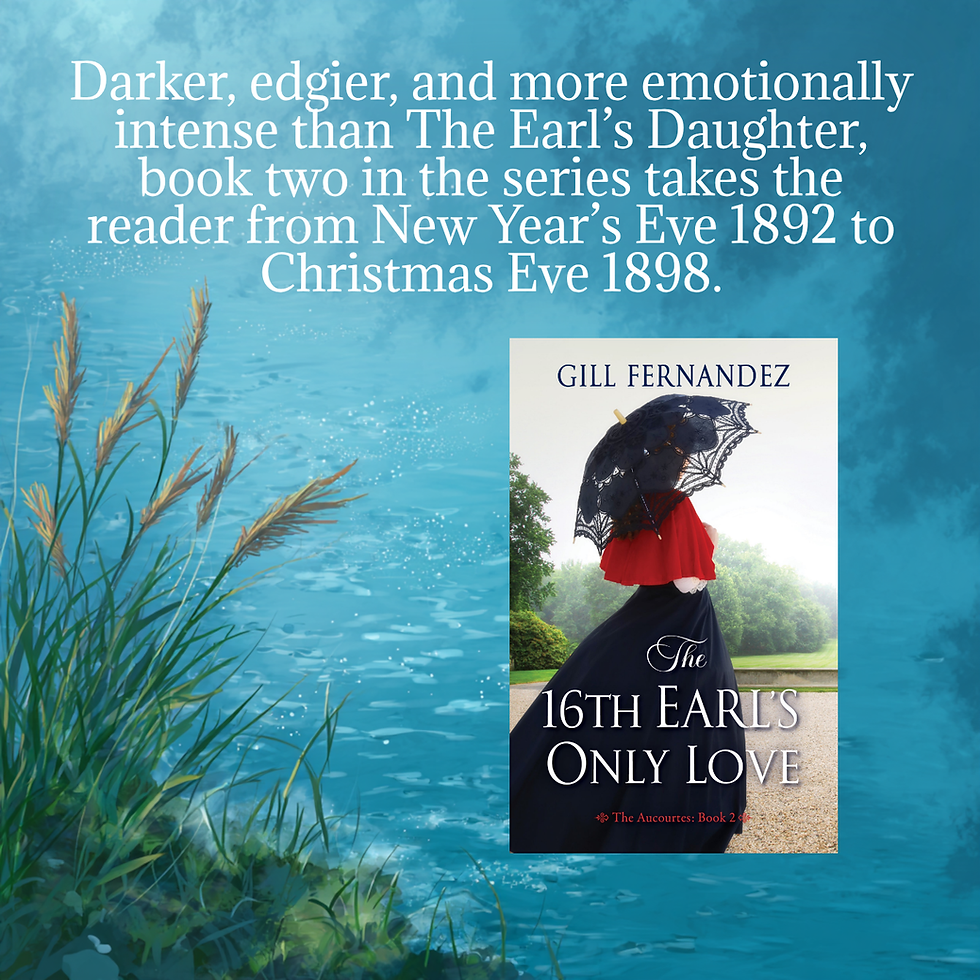
If you enjoy stories that span generations, then you’re already on this journey with me. The Earl’s Daughter and The 16th Earl’s Only Love, books one and two in the Aucourte Series, are only the fresh doorway into the story of a family. There are more tales to tell, more branches on the family tree to explore, and perhaps one day we’ll find ourselves back in Sussex, driving down the long approach to Whyton House in the late 1980s in a bright yellow VW Beetle, about to fall in love with Matthew.
As a free‑writer, otherwise known as a pantser, I didn’t plan any of this. But the families of Aucourte and Carver‑Phelan who live in my imagination clearly had plans of their own. In Matthew’s case, my guess is that he did not want to be forgotten and left to moulder in a storage box while his paper decayed. If you want to know more about the late Victorian part of these families' lives
follow the links in the above text, or if you would like to receive fortnightly updates on all that is happening with future books then join the Readers' Club. You'll receive a short story as a thank you for signing up.



Comments